
Airflow Visualization for Controlled Environments
Airflow visualization studies, often called smoke studies, provide qualitative evidence of how air moves through cleanrooms, clean zones, primary engineering controls (PECs), and other controlled environments. TSS uses visible tracer media and controlled delivery methods to document airflow behavior without materially disturbing the patterns being evaluated.
Depending on the application, a study can assess unidirectional airflow, first-air protection, sweeping action, turbulence, stagnation, reflux or entrainment, and airflow direction across doors or pass-throughs. These observations complement, but do not replace, quantitative cleanroom testing such as airflow velocity, room differential pressure, HEPA filter integrity, and particle concentration testing.
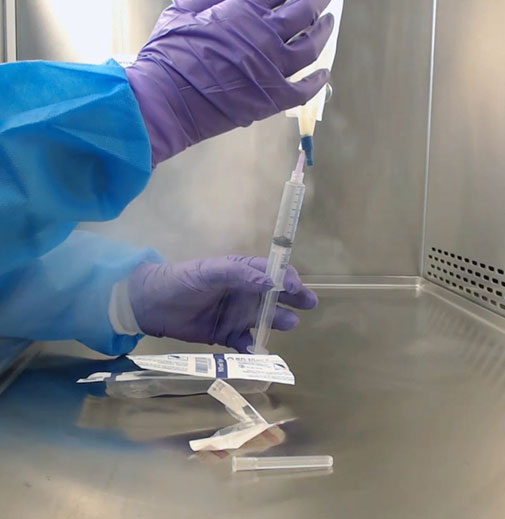
What an Airflow Visualization Study Includes
TSS develops the study scope around your process, facility configuration, applicable requirements, and approved procedures.
- Study execution: Services may include static and dynamic studies of laminar airflow workbenches, biosafety cabinets, isolators, restricted access barrier systems (RABS), rooms, doors, and pass-throughs, with routine operations and defined interventions simulated as needed.
- Visible media: Our standard method uses a neutrally buoyant visual medium (e.g., propylene glycol based) and a low-disturbance delivery approach. Alternate methods using liquid nitrogen, dry ice, or water for injection (WFI) may be provided when required by a client procedure. Because temperature and density can influence the visual medium behavior, the protocol should define the method and relevant limitations.
- Documentation: Deliverables can include a facility-specific protocol, video recording, indexed video files, and a written summary of the study conditions, methods, observations, and conclusions, as defined by the project scope.
When Airflow Visualization Is Used
Airflow visualization may be performed during initial qualification or commissioning; at periodic recertification where required; after changes to HVAC systems, HEPA filters, equipment, room layouts, or operating procedures; and when investigating airflow or contamination-control concerns.
For aseptic applications, dynamic studies should reflect actual operations and representative interventions rather than an empty-room demonstration.
Studies can be developed to support applicable requirements and guidance, including FDA aseptic-processing guidance, EU GMP Annex 1, ISO 14644-3, IEST recommended practices, USP <797>, USP <800>, USP <825>, CETA CAG-014, and, for pass-throughs, CETA CAG-015.
Governing requirements and acceptance criteria depend on the facility, process, equipment, and client procedures.
Benefits of a Well-Designed Smoke Study
A properly scoped study gives your team usable evidence. Key benefits include:
- Risk-based evaluation: Observe whether airflow protects critical sites and whether personnel, equipment, or interventions introduce contamination pathways.
- Qualification and change-control support: Document airflow behavior before use and after changes that could affect it.
- Troubleshooting: Identify turbulence, stagnation, reflux, entrainment, and unwanted airflow direction so corrective actions can be targeted.
- Inspection-ready documentation: Retain clear protocols, operating conditions, observations, conclusions, and indexed video when included in scope.
Schedule an Airflow Visualization Study
TSS supports pharmaceutical, biotechnology, healthcare, compounding pharmacy, medical device, and other controlled environment facilities nationwide. Our team can provide study planning, on-site execution, technical review, and project-specific reporting.
Call 800-877-7742 or use the contact form below to discuss your facility, applicable requirements, and desired deliverables.
