
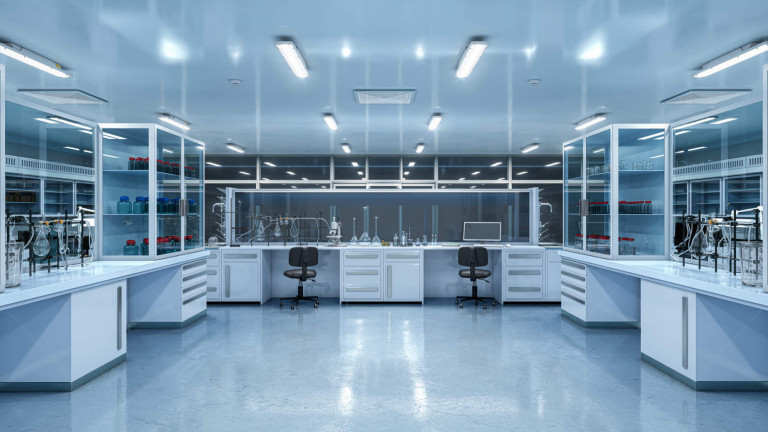
Cleanrooms & Their Importance
Cleanrooms are controlled environments designed to limit airborne contamination and support a specific process. The term “type of cleanroom” can describe several different characteristics, including the required cleanliness level, airflow pattern, construction system, contamination-control objective and industry application. A room should be designed around its intended use rather than selected from a single universal category.
Depending on the application, unwanted particles, microorganisms, fibers or chemical contaminants can affect product quality, research integrity, process yield or patient safety. Cleanrooms combine filtration, airflow, facility finishes, operating procedures and personnel controls to manage those risks at an appropriate level.
Cleanroom Classification Systems
ISO 14644-1 provides a widely used system for classifying air cleanliness by airborne particle concentration. The former U.S. Federal Standard 209E was canceled in 2001, although legacy terms such as Class 100 and Class 10,000 still appear in older specifications and industry conversations.
Classification is only one part of the requirements that may apply. Pharmaceutical, biotechnology, medical-device and compounding facilities may also follow GMP requirements, USP chapters, FDA regulations or other product- and jurisdiction-specific expectations. These frameworks can add controls for microbial contamination, facility design, qualification, monitoring and operations.
ISO 14644-1 expresses particle concentration limits per cubic meter and includes ISO Classes 1 through 9. FED-STD-209E used particles per cubic foot and a different class-naming convention, so legacy terms should be translated carefully rather than treated as current classifications.
By Cleanliness Level
ISO 14644-1 assigns ISO Classes 1 through 9 using maximum permitted airborne particle concentrations at specified particle sizes. The appropriate class depends on the process and applicable industry requirements; it does not by itself define airflow, gowning, pressure, temperature, humidity or microbial limits. For more information on particle limits and legacy Class 100/Class 10,000 comparisons, see ISO Cleanroom Classifications Chart & Guide.
By Application & Industry
Cleanroom controls should reflect the contaminants that matter to the process and the consequences of losing control. Common applications include:
- Pharmaceutical: Pharmaceutical facilities use different room grades and ISO classes based on the product, process and manufacturing stage. Aseptic processing typically uses highly controlled critical zones supported by cleaner background areas, while nonsterile operations may use different controls. Filtration, airflow, pressure relationships, material and personnel flows, gowning, cleaning, environmental monitoring and qualification should align with the contamination-control strategy and applicable GMP requirements.
- Biotechnology and Life Sciences: Cleanrooms may support biologics, cell and gene therapies, medical-device manufacturing or contamination-sensitive research. The design can require both product protection and containment, depending on the biological material and process. Filtration, pressure relationships, temperature and humidity, personnel practices and material transfer controls should be selected through a process-specific risk assessment.
- Microelectronics: Semiconductor, microchip, optics and related manufacturing processes can be sensitive to particles far smaller than those emphasized in many life-science applications. These facilities may combine stringent particle control with controls for electrostatic discharge, temperature, humidity, vibration and airborne molecular contamination.
- Food and Beverage: Controlled environments may be used for high-care processing, aseptic filling or other contamination-sensitive operations. The appropriate controls depend on the product and hazard analysis and may focus on microorganisms, allergens, foreign material or environmental conditions rather than ISO particle classification alone.
By Airflow Type
Airflow design affects how contaminants are removed, diluted or contained. The preferred technical terms are unidirectional and non-unidirectional airflow; “laminar” and “turbulent” are still commonly used but can oversimplify actual airflow behavior.
Unidirectional Airflow: Filtered air moves in a generally uniform direction across the critical area, carrying contaminants away from exposed product or sensitive work. The flow may be vertical or horizontal and may protect an entire room or a localized zone. Filter coverage and velocity are established by the design and process needs.
Non-Unidirectional Airflow: Filtered supply air mixes with room air and dilutes contaminants before reaching room returns or exhaust. This approach is common in many supporting and less stringent cleanrooms. Supply and return locations, equipment, personnel, heat loads and room geometry should be evaluated to avoid poorly mixed or stagnant areas.
By Construction Type
The following is a closer look at the construction types of cleanrooms and how they can each be utilized for various purposes throughout many industries:
- Modular Cleanrooms: These cleanrooms are designed utilizing prefabricated systems with either hard or soft walls. They offer faster installation than more traditional construction and fit many levels of ISO classifications.
- Hardwall Cleanrooms: Rigid wall and ceiling systems provide a durable enclosure that can support controlled pressure relationships and stable environmental conditions. Hardwall construction is commonly selected for permanent installations, but the achievable cleanliness level still depends on the complete HVAC system, envelope, process and operating program.
- Softwall Cleanrooms: Flexible curtains or panels create a localized clean zone, often with filtered air supplied from above. Softwall systems can be economical and easier to reconfigure, but they generally provide less control of pressure, temperature and humidity than sealed hardwall enclosure. They may be permanent or temporary depending on the application.
- Portable or Temporary Cleanrooms: Portable enclosures can support short-duration projects, phased construction, emergency capacity or processes that may later move. They can use softwall or hardwall components. Temporary status does not reduce the need to define, qualify and maintain the required environmental performance.
The choice among stick-built, modular, hardwall, softwall and portable systems affects installation time, cost, expandability, cleanability and environmental control. Construction type does not itself establish the ISO class; performance depends on the enclosure, filtration and airflow system, internal loads and operating practices working together.
Specialized Cleanroom Types
Some facilities require specialized controls beyond airborne particle classification:
- Temperature- and Humidity-Controlled Cleanrooms: There is no universal cleanroom temperature or relative-humidity setpoint. Limits should support the process, product, equipment, personnel comfort and contamination-control strategy. Humidity may also be important for electrostatic-discharge control, material behavior, corrosion risk or microbial control.
- Hazardous or Classified Locations: Processes involving flammable gases, vapors or combustible dust may require hazardous-location classification and appropriately rated equipment. ATEX applies in the European Union; U.S. facilities generally use the applicable electrical code and OSHA framework. Explosion protection requires a process-specific hazard assessment and may include ventilation, bonding and grounding, static control, monitoring and ignition-source control. A cleanroom classification does not replace this safety analysis.
- Gowning and Transition Areas: Airlocks and gowning rooms support controlled movement of personnel and materials into and out of the cleanroom. Their layout, pressure relationships and procedures should reduce contamination transfer and support the required gowning sequence. Air showers may be appropriate for some applications but are not a universal cleanroom feature.
Choosing the Right Type for Your Needs
Start with the process rather than the construction catalog. Define what must be protected or contained, the relevant contaminants, required operating state, applicable regulations and standards, personnel and material flows, equipment loads, environmental limits and plans for cleaning, monitoring and maintenance. Those requirements should drive the cleanliness level, airflow concept, pressure strategy and construction system.
Capital cost is only part of the decision. More stringent cleanliness, greater airflow, tighter temperature or humidity control and complex pressure relationships can increase energy use and maintenance demands. Include process equipment, utilities, heat generation, access, pass-throughs, future expansion and testing access in the design basis. Clear user requirements and early performance-verification planning help avoid both under-design and expensive overbuilding.
Technical Safety Services Is Here for You
The right cleanroom is the one that reliably supports its intended process and can demonstrate that performance through qualification, certification and ongoing monitoring. Technical Safety Services (TSS) provides cleanroom testing and certification, including airborne particle counting, airflow testing, room pressure testing, HEPA filter integrity testing and environmental monitoring. Contact us to discuss testing requirements for a new, modified or existing controlled environment.
