
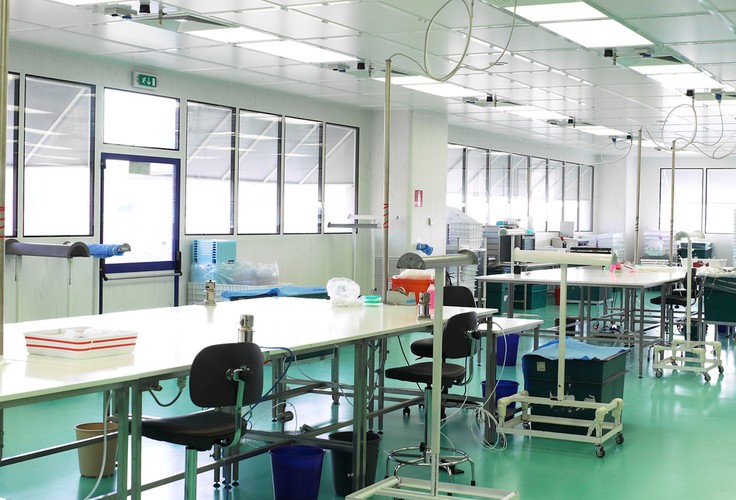
Cleanrooms provide controlled environments for products and processes that are sensitive to airborne contamination. They are used across pharmaceuticals, medical devices, biotechnology, electronics, aerospace and other industries where particulate control can affect product quality, process performance or patient safety.
ISO cleanroom classifications provide a standardized way to describe airborne particle cleanliness. The appropriate classification is established from the needs of the product and process, applicable regulations or industry guidance, and the facility's contamination-control strategy. Classification is therefore one part of cleanroom design and control, not a complete design specification by itself.
What Is a Cleanroom Classification?
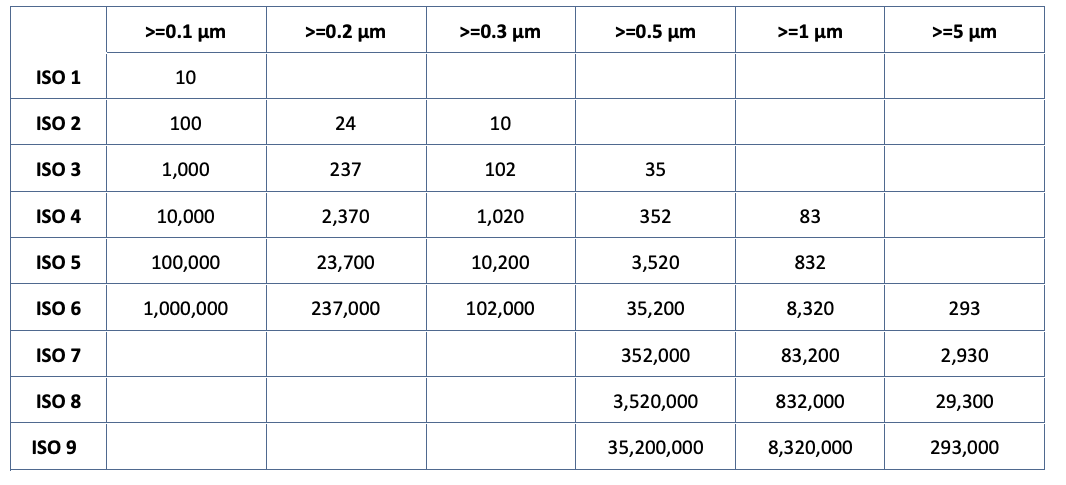
ISO 14644-1 classifies air cleanliness by the concentration of airborne particles at specified particle sizes. ISO Class 1 is the most stringent of the nine classes, while ISO Class 9 permits the highest particle concentrations. The assigned class is verified by measuring particle concentrations at defined sampling locations and comparing the results with the applicable class limits.
Facilities use a combination of filtered air, airflow management, pressure relationships, cleaning, gowning and operating practices to achieve and maintain the required cleanliness level. The specific controls depend on the process and contamination risks. Where microbial contamination is important, viable environmental monitoring is typically addressed separately from ISO particle classification.
ISO 14644-1:2015 remains the current international standard for classification of air cleanliness by particle concentration. Legacy references to U.S. Federal Standard 209E, including terms such as Class 100 or Class 10,000, may still appear in older specifications, but FED-STD-209E was cancelled in 2001 and superseded in practice by ISO 14644.
For sterile medicinal-product manufacturing, EU GMP Annex 1 also uses Grades A, B, C and D. These grades incorporate particle limits but are not simply alternate names for ISO classes; Annex 1 also establishes expectations for qualification, monitoring and contamination control, and some particle limits differ between at-rest and in-operation conditions. ISO classification and an applicable GMP grade should therefore be evaluated within their own regulatory context.
The chart below summarizes the maximum permitted particle concentrations in ISO 14644-1:2015 Table 1. A classification should identify the ISO class, the particle size or sizes being evaluated, and the occupancy state in which testing is performed (as-built, at-rest or operational). The classification selected for a facility should reflect the product, process and applicable quality or regulatory requirements.
Key Considerations for ISO Cleanroom Classification Testing
A defensible classification plan should address the following fundamentals:
- Sampling locations and volume: ISO 14644-1 establishes a minimum number of sampling locations based on the cleanroom or clean-zone area. The locations should be distributed representatively, and the sample volume at each location must be sufficient for the class and particle size being evaluated.
- Particle-counter suitability and setup: Classification uses a light-scattering airborne particle counter (LSAPC). The instrument and sampling configuration should be suitable for the particle sizes, sample volume and airflow conditions being evaluated.
- Test condition and instrument calibration: The occupancy state and operating conditions should be defined before testing so results are interpreted correctly. The particle counter should have a valid calibration certificate and be calibrated in accordance with ISO 21501-4, with calibration frequency managed through the applicable quality system and manufacturer recommendations.
Technical Safety Services (TSS) provides cleanroom testing and certification services for controlled environments nationwide. Services include ISO 14644 nonviable particle classification, airflow volume and velocity testing, room differential pressure measurements, HEPA filter integrity testing, recovery testing, viable environmental monitoring and other qualification testing based on facility and industry requirements. Contact TSS to discuss the testing program appropriate for your cleanroom.
